
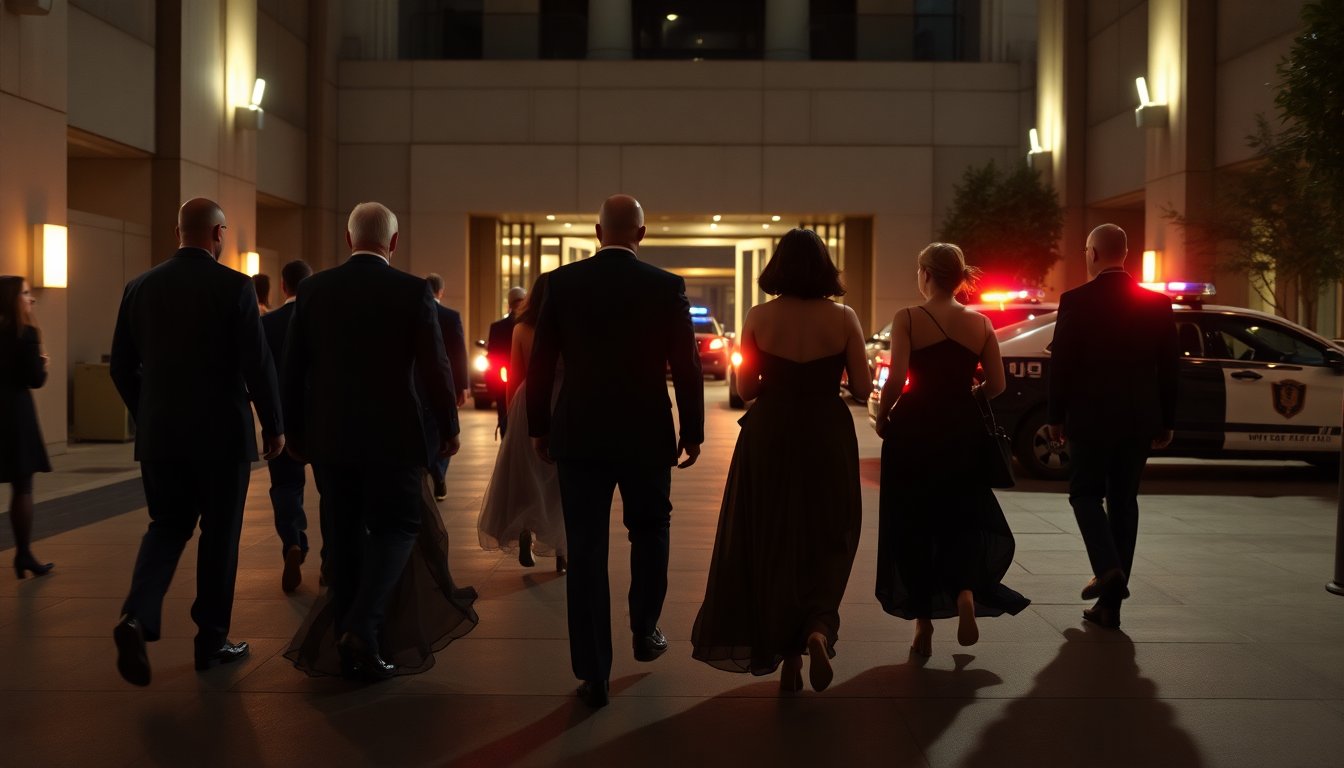
On 26/04/2026, the annual White House Correspondents’ Dinner at the Washington Hilton was interrupted when gunfire was reported near a security checkpoint. Guests, including President Trump and First Lady Melania Trump, were escorted away from the ballroom by agents after audible bangs created confusion and fear among attendees. The incident unfolded despite heightened protections already in place for the president, and the night ended with a suspect in custody and at least one injured agent who has since been released from hospital care.
The account that follows reconstructs the timeline, law enforcement actions, suspect information and the broader security implications. Throughout this report you will see key terms emphasized and select concepts marked with italics to clarify operational practices used by protective services during incidents involving a sitting president.
How the incident unfolded
Attendees describe hearing several loud pops inside or near the hotel ballroom, after which visible members of the Secret Service reacted immediately. Pool reports said agents drew weapons and moved the press and guests away while shouting warnings. The president and others were escorted through a secured route commonly referred to as the presidential exit corridor, a controlled pathway designed to move protectees quickly and safely out of a venue. At first, organizers indicated the program might resume, but later law enforcement directed evacuation consistent with standard protocol.
Witnesses reported people ducking under tables and security personnel jumping between chairs to reach protected individuals. The press pool was separated from the motorcade for a time, and updates about the president’s exact location were delayed while agents completed their tactical assessments. In a social media post, the president praised law enforcement and said the suspect had been detained; he also noted plans to reschedule the dinner within 30 days.
Law enforcement response and arrest
Authorities identified the suspect as Cole Tomas Allen, a 31-year-old believed to have traveled from Torrance, California. Reports indicate the confrontation occurred at an outer security screening area, where the perpetrator exchanged fire with agents before being taken into custody on the scene. A Secret Service agent was struck in his ballistic vest and later released from hospital, illustrating how protective equipment and rapid medical attention can limit casualties in such situations.
Federal and local agencies converged on the hotel immediately. Photographs and eyewitness footage show uniformed agents, National Guard members and emergency responders with weapons drawn and securing the perimeter. The FBI and other investigative bodies later executed searches at an address linked to the suspect in Torrance as authorities sought to determine motive, possible planning and any wider threats. Officials reported the suspect spoke of targeting members of the administration and had a written manifesto, according to law enforcement sources.
Suspect background and charges
Preliminary reporting describes Allen as having traveled cross-country with intent to attend the event area; investigators have been reviewing his digital footprint and travel records. The individual was taken into custody without prolonged pursuit and remains the focus of a federal inquiry into attempted assassination and related offenses. Authorities are examining whether the act was solitary or linked to others, and have been candid about the need to corroborate early claims before charging decisions are finalized.
Security context and implications
The Washington Hilton has particular resonance in presidential security planning because of historical events at the venue, most notably the 1981 assassination attempt on President Ronald Reagan outside the hotel. Those earlier lessons informed the hotel’s protected routes and screening procedures. Still, security professionals acknowledge limits: a public, operating hotel cannot be comprehensively searched room by room while functioning normally, and agents balance openness with protective measures. The incident has sparked questions about screening placement and whether perimeter controls should be extended further from event spaces.
Former protective service officials explained that a measured withdrawal—sometimes described as a tactical pause—can be prudent to avoid moving a protected individual into a second, unforeseen danger. That approach appeared to factor into decisions made the night of 26/04/2026. As investigations continue, organizers and security agencies will likely reassess checkpoint positioning, guest access procedures and intelligence-sharing practices to reduce the chance of similar breaches at high-profile gatherings.
Aftermath and public communication
Following the incident, government officials and event leaders focused on accounting for attendees, coordinating medical care, and communicating with the public. The president said he would hold a briefing from the White House shortly after leaving the site and emphasized the safety of top officials. Media organizations present at the dinner reported delays in reporting as pools were sheltered and later transported away from the venue. For the broader public, the episode underscored the ongoing challenges of securing major events while maintaining access for invited guests and credentialed journalists.
Investigations remain active and this account will be updated as authorities release further findings. The arrest at the Washington Hilton on 26/04/2026 reopened debates about event security, the balance between openness and protection, and how to prevent individuals with harmful intent from reaching sensitive locations where national leaders gather.


