
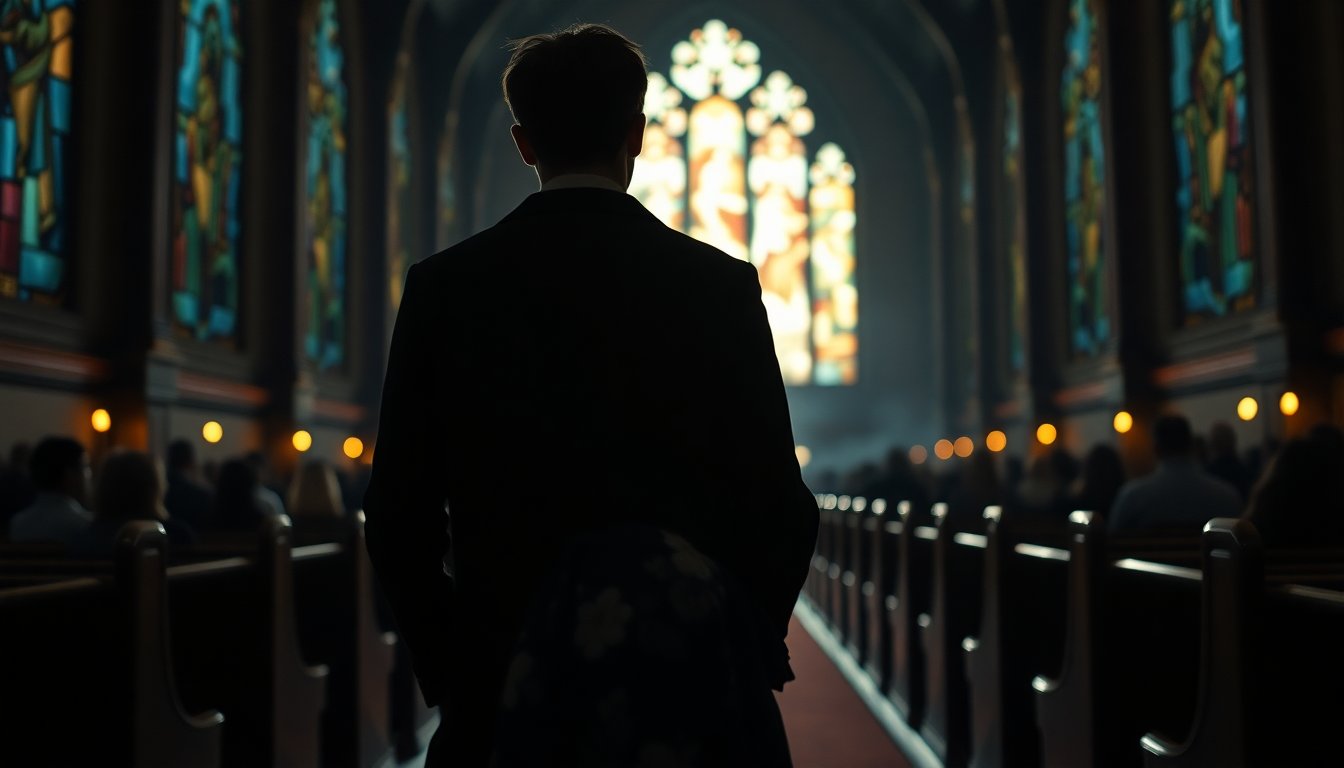
The history between the queer community and the horror genre is long and layered, with many films serving as coded reflections of the queer experience. In Leviticus, debut director Adrian Chiarella removes subtext and places queerness and religious violence side by side in a story that reads as both a coming-of-age drama and a supernatural nightmare. The film’s tone leans into dread rather than metaphor, asking audiences to sit with the raw consequences of fear-driven faith communities.
At the center of the film is Naim, portrayed by Joe Bird, a teen who moves with his single mother (played by Mia Wasikowska) to a small, devout town. There he forms a furtive bond with his classmate Ryan (Stacy Clausen), and the pair’s closeness becomes the target of communal panic. A church ritual—presented in the film as a violent form of conversion therapy—sets in motion a supernatural affliction: victims are haunted by a spirit that mimics the face of their desire. The premise reframes real-world coercion as literal, relentless horror.
Plot and thematic spine
The narrative tracks Naim’s isolation, his tentative and tender connection with Ryan, and the unraveling that follows when jealousy leads to a denunciation. What begins as a shame-infused ceremony quickly becomes an encounter with forces no one can explain. The film treats the ritual not merely as a cruel practice but as a catalyst for a malevolent presence that stalks its victims, appearing as the person they long for. That device turns intimacy into a source of terror, forcing characters and viewers alike to confront the stakes of enforced conformity. Throughout, Leviticus interrogates how religious doctrine can be weaponized against love and selfhood.
The book and the backlash
Chiarella draws on the cultural weight of the Book of Leviticus—a portion of scripture often cited to justify anti-queer positions—to frame the film’s moral panic. Rather than a theological treatise, the movie is a study of how selective readings of scripture become communal law, shaping rituals that dehumanize. The film’s fictional deliverance, portrayed with grim detail, stands in for historic and contemporary conversion therapy practices: it humiliates, it isolates, and it creates long-lasting psychological harm. By literalizing the consequences, the film asks audiences to reckon with the real damage of spiritualized violence.
Craft, performances, and directorial intent
On a technical level, Leviticus blends atmospheric camerawork and surgical editing to sustain dread. Chiarella stages quiet scenes that swell into sudden, visceral shocks, and a few sequences—like a tense bus ride and an eerie abandoned mill—stick with you long after the credits. The cast commits fully: Bird and Clausen convey adolescent tenderness with understated clarity, while Wasikowska anchors the film’s domestic fear. Nicholas Hope’s unsettling figure as the man who presides over the ritual adds a cruel theatricality. The movie uses genre mechanics—jump scares, mounting paranoia—to mirror the shrinking world young queer people sometimes experience.
Director’s perspective and reclamation
Chiarella has positioned the film as an attempt to claim space within a tradition where queer creators historically encoded their stories in horror. Rather than hide, the director foregrounds the violence inflicted by dogmatic communities, reclaiming the language of monstrosity to show who is labeled a monster and why. The film’s emotional honesty complements its stylistic choices, making it more than a sequence of scares: it becomes a deliberate act of storytelling that argues for visibility and for recognizing the real-world parallels to its supernatural conceit.
Reception and cultural impact
Leviticus premiered to strong audience reaction at the Sundance Film Festival, where packed screenings reacted with audible shock, laughter, and applause. Indie distributor Neon acquired the film for wide release following festival momentum, and the studio slated the theatrical opening for June 19. That timetable positions the film within a season of heightened discussion about queer representation and the politics of religion, increasing the likelihood that it will spark conversations beyond genre fans. Critics and audiences have noted the film’s capacity to cross over from a queer cult favorite to a mainstream horror touchstone.
Ultimately, Leviticus matters because it refuses to sanitize the queer experience in service of allegory. By turning ritual shame into a literal, inescapable presence, the film invites viewers to feel the claustrophobia of coercion while celebrating small, defiant acts of affection. Whether you come for the scares or the social critique, the movie stakes a claim: horror can be a vehicle for truth, and in this case, the truth is urgent and uncompromising.


