
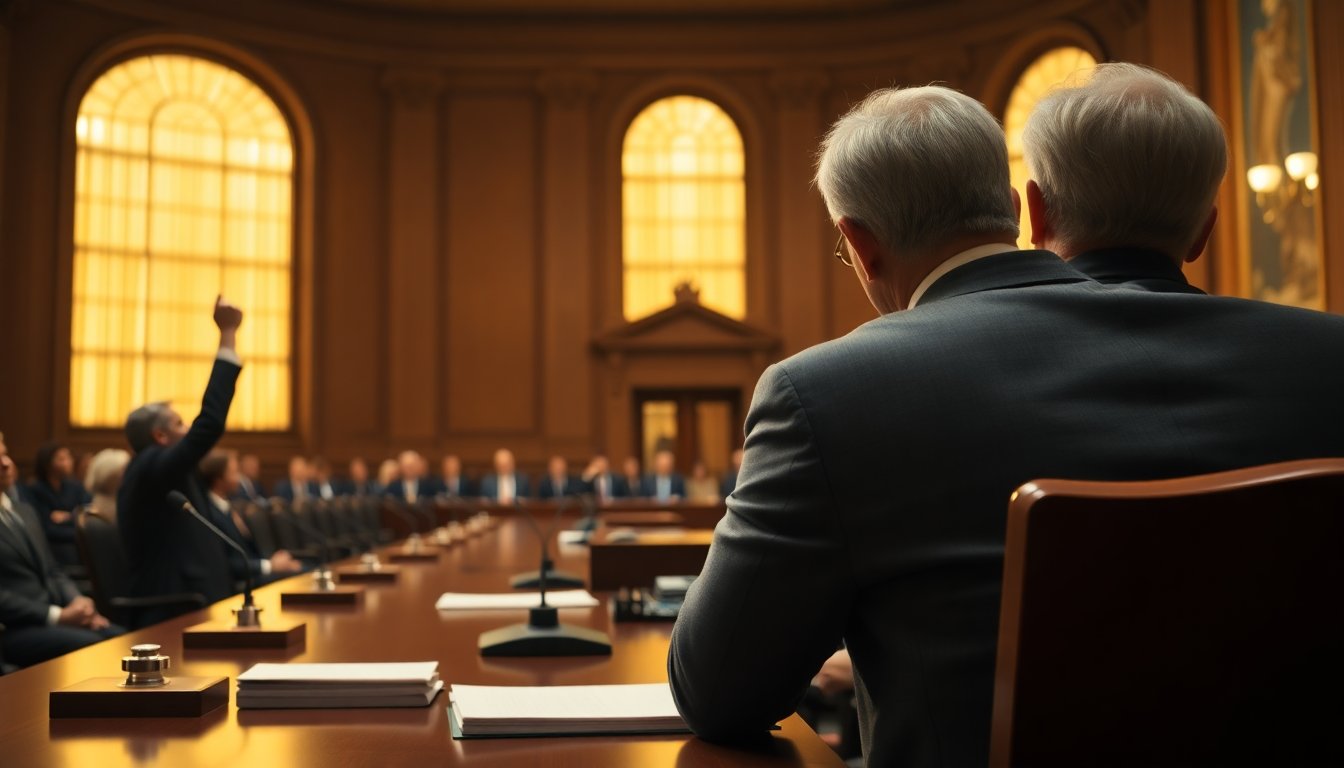
The House Education and Workforce Committee hearing on April 17, 2026 produced a heated exchange that combined questions about presidential capacity with wide-ranging disputes over public health policy. Mental fitness and the limits of constitutional remedies were central as Rep. Mark Takano (D-CA) directly asked Secretary Robert F. Kennedy Jr. whether he would insist that President Donald Trump submit to a formal assessment of his mental and emotional stability. Kennedy declined, arguing the president was fit for office, while Takano cited specific public posts by the president as evidence prompting concern.
Takano pointed to a post on April 7 in which Trump wrote, “A whole civilization will die tonight,” and to a subsequent stretch of overnight activity that included a harsh attack on a pontiff and an AI-generated image depicting the president in a religious guise. Takano framed the question not as partisan theater but as a national-security matter: in a time of war, he said, leaders must show unimpaired judgment. The congressman also reminded the secretary of the 25th Amendment, the constitutional process for addressing presidential incapacity.
The confrontation over a mental fitness assessment
In his questioning, Rep. Takano sought an explicit commitment: would the secretary insist the president undergo professional evaluation for his cognitive and emotional state? Takano argued that repeated, late-night posts and a controversial image were more than rhetorical excess; they raised questions about the president’s ability to direct military operations. 25th Amendment responsibilities were invoked as a duty of officeholders to act if a president becomes unable to perform duties. Secretary Kennedy responded simply and decisively: “Absolutely not,” and insisted there has not been a more mentally sound president, rejecting the premise that an assessment was warranted.
Why lawmakers pressed the point
Lawmakers pressing the matter cited both content and cadence of social-media behavior as relevant indicators. Takano emphasized uninterrupted posting from 9 p.m. to 5 a.m. and a depiction the president later said was intended to be a doctor, not a messianic figure. For representatives who raised the point, the concern was practical: a commander in chief must be demonstrably stable. The exchange touched on public trust, the optics of leadership in wartime, and the threshold for invoking constitutional mechanisms meant for rare and serious circumstances.
Medical voices and concerns about cognitive decline
Outside the hearing room, health professionals and family members have weighed in on similar questions. Critics such as Dr. Vin Gupta have described speech and thought patterns they view as consistent with emerging dementia or other cognitive impairment, while Dr. John Gartner has pointed to coordination and articulation changes over time. These observers note signs such as word-finding difficulty and an altered gait as reasons for concern. Such clinical impressions, however, differ from formal diagnosis and from the legal standards that trigger constitutional remedies.
Family observations and past exams
Family commentary has also entered the public record. Mary Trump, a psychologist and niece of the president, has previously asserted that clinical observations point toward cognitive and emotional decline. Publicly available accounts refer to a cognitive screening conducted during a physical at Walter Reed National Military Medical Center in January 2018, when the president reportedly scored a perfect 30 on a standardized test. That exam and accompanying imaging such as an MRI are tools clinicians use to evaluate brain health, but advocates for further assessment argue that isolated test results do not preclude emergent changes over time.
Other flashpoints at the hearing: vaccines, autism and gender care
The session expanded well beyond questions about the president. Secretary Kennedy defended himself against criticism about his long-standing scrutiny of vaccines, telling lawmakers he is “not anti-vaccine” and describing his stance as pro-science while urging stronger safety testing. Democrats raised measles outbreaks and recent pediatric deaths, and pressed Kennedy on whether his rhetoric had contributed to vaccine hesitancy. Lawmakers also demanded an apology for comments about autism made by the secretary; Kennedy maintained he was referring to severe, life-limiting forms of the condition.
Republicans questioned the administration’s approach to gender-affirming care for minors. Secretary Kennedy said the department had ended federal funding for puberty blockers and what he described as unnecessary surgeries, warning that institutions offering these interventions risk losing Medicaid and Medicare dollars. He also remarked that certain special education programs might be more appropriately administered by HHS rather than the Department of Education, noting that Secretary Linda McMahon has authority to reassign program responsibilities.
Implications and next steps
The hearing crystallized a broader dynamic: elected officials and public health leaders are navigating an intersection of governance, medicine and media behavior. Questions about a president’s mental state are legally and politically fraught, and clinicians, family members and policymakers offer differing standards for concern. Meanwhile, Secretary Kennedy faces continued scrutiny over his department’s stance on vaccines, autism-related rhetoric and pediatric gender care, and the debate is likely to continue in follow-up hearings and public commentary.


