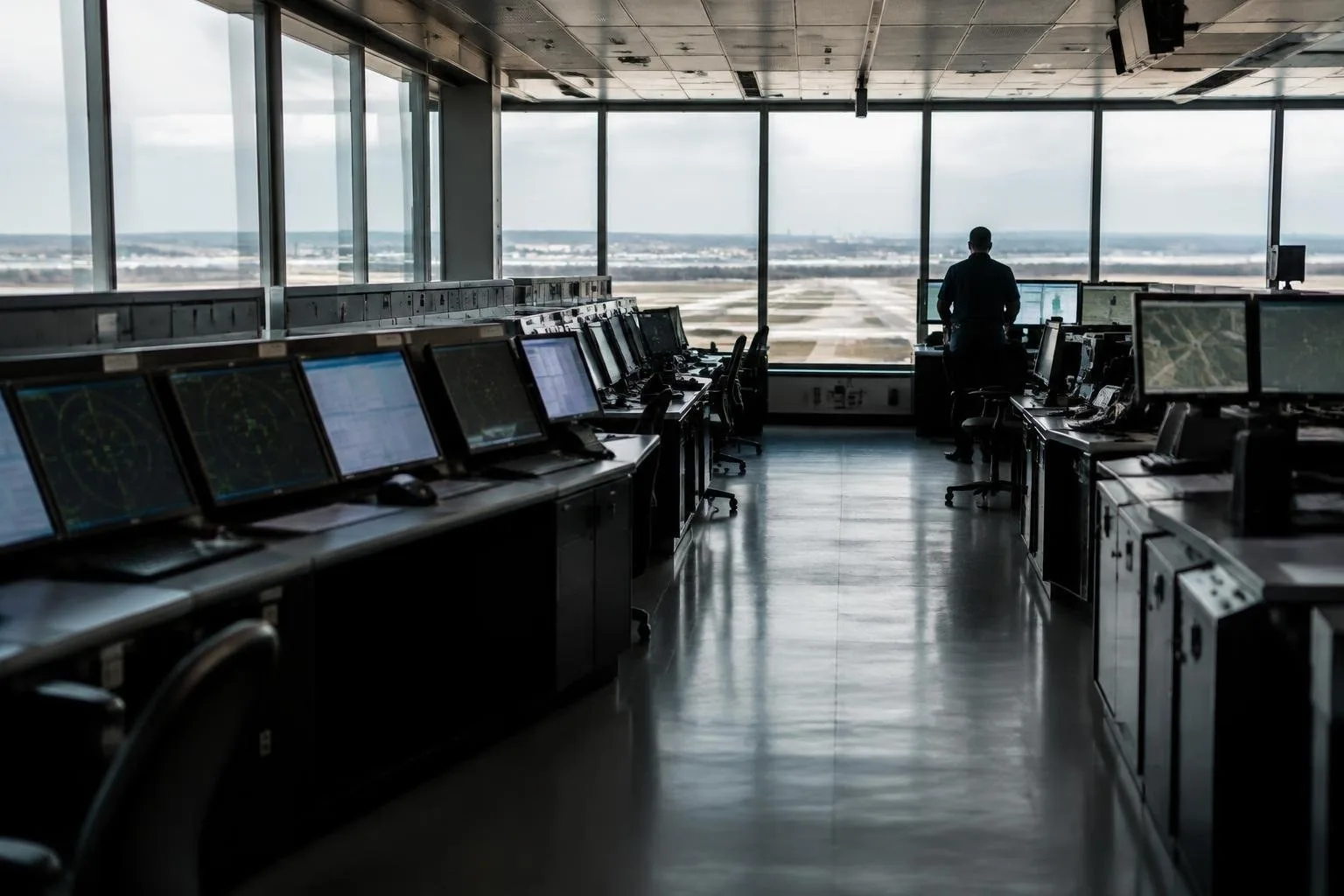
On a Friday afternoon, the Federal Aviation Administration issued an unprecedented ground stop that grounded departing flights across the United States. The emergency directive came at 3:54 p.m. Eastern, citing “extraordinary circumstances and for reasons of safety.” More than 3,500 aircraft were airborne when the directive took effect, and technicians scrambled to stabilize a communications network that had begun delivering inconsistent data.
By 8 p.m. Eastern, the airspace had reopened, but the disruption had already forced the cancellation of over 1,000 flights and delayed nearly 10,000 others. Aviation analytics firm Cirium estimated that about 1.5 million passengers on roughly 11,000 scheduled flights were affected. The incident unfolded while the White House was asking Congress for an additional $30.1 billion for aviation infrastructure, including $10.1 billion earmarked for air traffic control upgrades.
Technical glitch and the officials’ response
Transportation Secretary Sean Duffy described the failure as an overload of switches and routers that constitute the FAA’s legacy telecommunications backbone. “Our switches, our routers actually got overloaded with data, and they started to give us inconsistency in the data from those routers,” he said, later correcting himself to avoid saying the equipment “went down.” Homeland Security Secretary Markwayne Mullin added that new equipment introduced by the administration was “overwhelming the older system,” though he did not specify which technology was involved.
Both secretaries repeatedly emphasized that no cyber-attack had been detected, noting that investigators “found no evidence of an intrusion.” Mullin’s assessment shifted from a confident dismissal of hacking to a more guarded “there’s nothing completely certain right now.” The officials also distanced the outage from the FAA’s AI-assisted SMART planning tool, describing it as unrelated to the affected communications pathways.
During the briefing, Mullin praised President Donald Trump, declaring, “This is what the leadership of President Trump looks like,” and adding that the president “loves aviation… he understands it very well.” Duffy echoed the sentiment, saying the president was “deeply engaged” through private conversations, even though Trump had not addressed the crisis publicly on his Truth Social platform. When asked why the president had not spoken directly to travelers, Duffy replied, “I don’t run the president’s comms.” The White House press secretary role remained vacant after Katie Zacharia’s brief five-day stint in October.
Infrastructure gaps and the funding battle
The outage sharpened scrutiny of the FAA’s ongoing modernization program. A 2024 Government Accountability Office report classified 51 of the agency’s 138 air traffic control systems as “unsustainable” and another 54 as “potentially unsustainable.” Although the FAA has replaced about 68 % of its copper telecommunications network with high-speed fiber, officials cautioned that swapping cables alone cannot erase systemic vulnerabilities.
Congress approved $12.5 billion in July 2025 to replace outdated telecommunications, radar, and other aviation systems. Secretary Duffy argued that the allocation was insufficient, demanding “$50 billion” to fully modernize the network. Mullin blamed Republican lawmakers for “kicking the can down the road,” suggesting that the current funding shortfall was a product of legislative inaction. The administration’s request for an extra $30.1 billion, of which $10.1 billion targets air traffic control, underscores the scale of the challenge.
Former Transportation Secretary Pete Buttigieg, speaking at the “What’s Next” conference in Denver where many Democrats gathered, refrained from partisan speculation but questioned why existing redundancies failed to contain a disruption of this magnitude. “It is not clear to me why the redundancy did not prevent an outage of this magnitude,” he said, urging transparency and praising career employees for keeping the skies safe.
Both Duffy and Mullin concluded the briefing by lauding the president’s leadership. Mullin stated, “You’ve never had a builder and a leader like President Trump lead this nation, have a vision and put the team together,” while Duffy admitted, “We didn’t think we would have this kind of outage.” The episode leaves the nation watching as the FAA aims to complete its first modernization phase by December 2028, with the risk that unresolved legacy weaknesses could trigger further nationwide disruptions.