
The story of The Rocky Horror Picture Show is not just a chapter in film history; it’s a continuing social performance. In Strange Journey: The Story of Rocky Horror, director Linus O’Brien — working with archival clips, interviews and contemporary audience footage — follows his father, Richard O’Brien, from experimental London theater rooms to the screens and stages that made the work an enduring cultural touchstone. The film positions the musical as an amalgam of influences — from horror cinema and romance comics to Mary Shelley’s Frankenstein — and highlights how a creative, low-budget staging blossomed into a global cult film phenomenon.
Rather than a strict biography, the documentary reads like a guided tour through a creative ecosystem. Using testimony from collaborators such as director Jim Sharman, composer Richard Hartley, and original performer Tim Curry, Linus reconstructs the early rehearsals where much of the piece came to life. Richard O’Brien himself explains his songwriting methods with characteristic modesty, noting that key numbers emerged quickly once the dramatic circumstances were clear. The film makes a point of showing how initial improvisation and collective energy in rehearsal rooms seeded the long-term vitality of the work.
Theatre roots and the rapid birth of songs
At its inception, The Rocky Horror Show relied on minimal sets and maximum invention. Linus’s film highlights how the original London staging used whatever the Royal Court Theatre could offer: scaffolding, painted flats and inventive lighting. According to the documentary, about 60 percent of the story and songs were drafted before rehearsals, with the remaining material often composed while the company was on its feet. This hybrid of preplanning and spur-of-the-moment composition explains why signature tunes like “The Time Warp” and Janet’s ballad acquired such immediacy: they were answers to dramatic needs discovered in rehearsal rather than polished commercial products.
A son’s portrait: making a personal film about a public work
Linus approaches his subject with dual aims: to celebrate Richard O’Brien’s imaginative achievement and to honor the unexpected afterlife of that work. Strange Journey includes warm recollections from screen stars such as Susan Sarandon and Barry Bostwick, as well as perspectives from contemporary admirers like Trixie Mattel and Jack Black. The documentary’s production team includes figures known for music and cultural retrospectives, and their archival research ties the theatrical staging to the later film adaptation. Linus intentionally foregrounds the relationship between creator and community, showing how personal modesty and widespread fandom became complementary forces behind the story’s longevity.
How the film adaptation almost failed
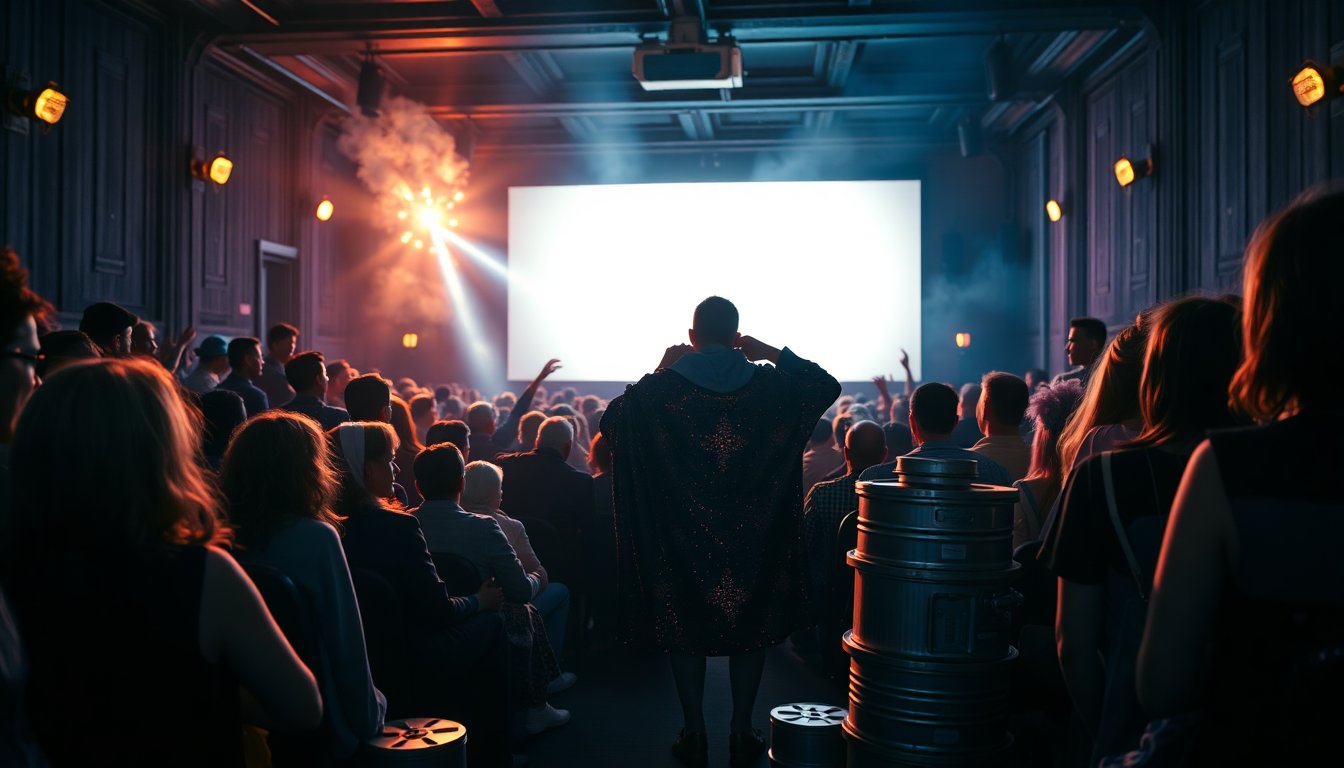
The film version, distributed by 20th Century Fox, did not immediately find an audience. When the movie first circulated in 1975 it struggled at the box office. The documentarian traces the pivot that saved it: re-launching the movie as a late-night feature at New York’s Waverly Theater. Beginning in April of ’76, that venue staged midnight screenings that invited active participation. Audiences began to shout dialogue, bring props, and later perform alongside the projected film. This shift from passive viewing to communal ritual transformed a commercial disappointment into an enduring theatrical event.
The audience as performer: midnight screenings and shadow casts
One of Linus’s central arguments is that the film’s long life belongs as much to its fans as to its creators. The documentary documents the birth of shadow casts — groups who perform the film live in front of the screen — and shows how these ensembles preserve the piece as a shared experience. Linus frames this practice as a kind of cultural transmission: the rehearsal period’s exuberance ripples outward into decades of audience-generated performance. The result is a living tradition where strangers gather in costume, call back lines, and dance the Time Warp together.
Legacy and continuity
Richard O’Brien reflects on the unpredictable arc of his creation with a bemused perspective, calling some of the most powerful audience moments “spontaneous theater.” For him, a rendition of “I’m Going Home” performed by a live singer during a screening illustrated how cinema and live performance can converge. Linus closes the film by amplifying fan voices and contemporary footage of screenings, underscoring that what began as a quirky rock opera has become an intergenerational ritual. As the documentary makes clear, the work’s survival depends on continual reinvention by those who turn a movie night into a communal event.
Strange Journey is presented as both a family homage and a cultural study. By combining creator testimony, production anecdotes and images of modern-day audiences, Linus O’Brien builds a layered account of how an idiosyncratic musical achieved global staying power. For anyone curious about how a modest theatrical experiment metastasized into the longest-running theatrical release in history, the film offers a lively, affectionate roadmap: it is about invention, reception, and the unpredictable alchemy that makes a cult classic endure.


