
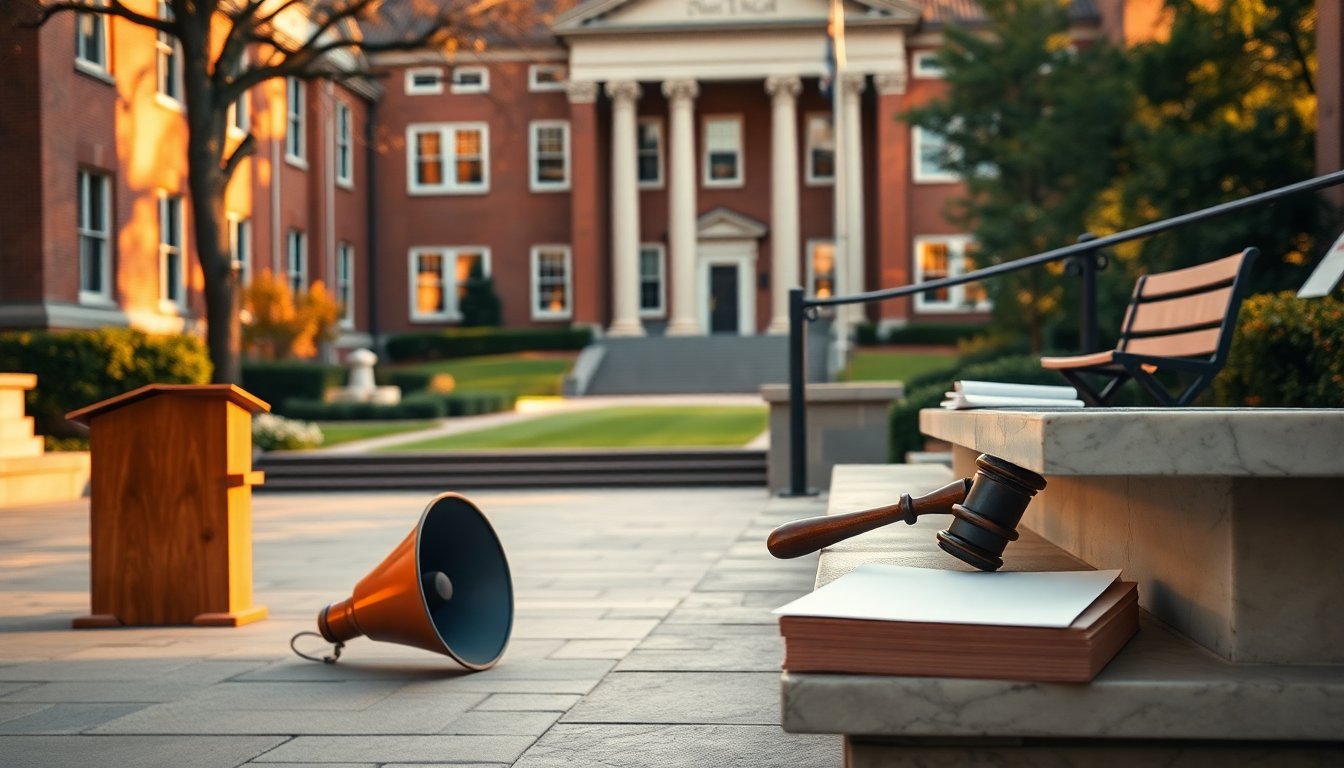
The Tennessee legislature has advanced a measure known as the Charlie Kirk Act, which, if approved by Governor Bill Lee (R), would sharply limit how public colleges and universities may respond to campus speakers and on-site demonstrations. Supporters present the bill as an effort to strengthen free speech protections at public institutions, but critics warn it would penalize students and faculty who try to disrupt or block appearances by controversial figures. The proposal sets out both procedural changes and disciplinary mechanisms aimed at curtailing tactics commonly used by protesters to oppose invited guests.
At the heart of the measure is a requirement that colleges adopt a specific model policy and that institutions refrain from taking adverse action against people based on certain viewpoints. The bill explicitly bars public institutions from discriminating or retaliating against individuals because of their stance on homosexuality or transgender behavior, irrespective of whether that opposition stems from religious belief or other motives. The text also instructs campuses to implement the University of Chicago’s Freedom of Expression Policy, a document that emphasizes the university’s role in allowing even offensive ideas to be expressed without institutional suppression.
What the law would change on campus
Practically, the legislation enumerates a range of actions that campuses would be prohibited from treating as permissible forms of protest when they interfere with events. These include making sustained noise to drown out a speaker, physically obstructing a speaker’s view with one’s body or signage, staging walkouts that cause significant interruption, and stopping people from entering venues. Under the proposed rules, such tactics could be classified as violations leading to disciplinary sanctions for both students and faculty. The bill frames these prohibitions as necessary to protect invited speakers and to ensure events proceed without disruption.
Discipline and enforcement
The enforcement provisions make clear that consequences may include probation, suspension, or expulsion for students, and analogous penalties for faculty members depending on institutional codes. By mandating adoption of a particular free expression policy, the law transfers a degree of control over campus conduct from individual administrators to a standard that privileges expression over suppression. The bill cites language from the model policy stressing that debate should not be stifled even when ideas are thought to be offensive, unwise, immoral, or wrong-headed; it asserts that members of the campus community, rather than the institution, should judge and contest ideas through open debate.
Origins, namesake and the context of controversy
State Representative Gino Bulso (R) sponsored the bill and defended its nameplate, saying it honors a speaker who stood for what Bulso described as civil expression. The namesake, Charlie Kirk, was shot and killed in September at a public event at a university in Provo. Kirk had been a widely known right-wing activist and podcaster whose public remarks included abrasive and disparaging comments about racial and LGBTQ+ communities. At the time of his planned appearances, students at Utah Valley circulated an online petition—garnering close to 1,000 signatures—seeking to block his visit; university leaders opted to permit the event, citing a commitment to free expression and dialogue.
Aftermath and political debate
The aftermath of Kirk’s death included a contentious debate over how institutions and colleagues responded. Some individuals who publicly refused to mourn were later disciplined or removed from positions, a point raised by Tennessee lawmakers who argued that disciplinary actions in their state underscored the need for clearer protections for invited speakers. Critics counter that invoking the incident to limit campus dissent ignores the substantive harms caused by the speaker’s rhetoric. The sponsor maintained that Kirk promoted love and faith and deserved recognition for his commitment to expression, while opponents say the bill elevates provocateurs and restricts communities’ ability to oppose harmful speech.
Implications for LGBTQ+ communities and campus discourse
Advocates for LGBTQ+ rights are particularly alarmed by the clause shielding viewpoints critical of homosexuality and transgender behavior from institutional discipline, arguing the language effectively protects discriminatory expressions under the mantle of viewpoint neutrality. Campus organizers warn that ordinary protest tools—noise, physical presence, and walkouts—are vital tactics of civil expression and collective safety when responding to speakers whose messages many students find dehumanizing. By criminalizing these tactics through academic discipline, the law could chill student activism and make it harder for marginalized groups to assert their rights to a campus environment they consider safe and respectful.
For students and staff navigating this changing terrain, practical steps include documenting incidents, seeking clarification from campus policy offices about the required model policy, and engaging in lawful counter-speech and organized advocacy. Legal and academic observers note that the balance between protecting expression and preventing harassment will likely be litigated or tested through campus hearings if the governor signs the bill. The outcome will shape how public colleges interpret free speech and protest norms in Tennessee for years to come.
As the measure awaits the governor’s decision, stakeholders across higher education and civil rights communities are preparing for its possible effects. Whether framed as a defense of open debate or a restriction on dissent, the Charlie Kirk Act marks a consequential intervention in the contested space where campus safety, academic freedom, and the rights of marginalized students intersect.


